
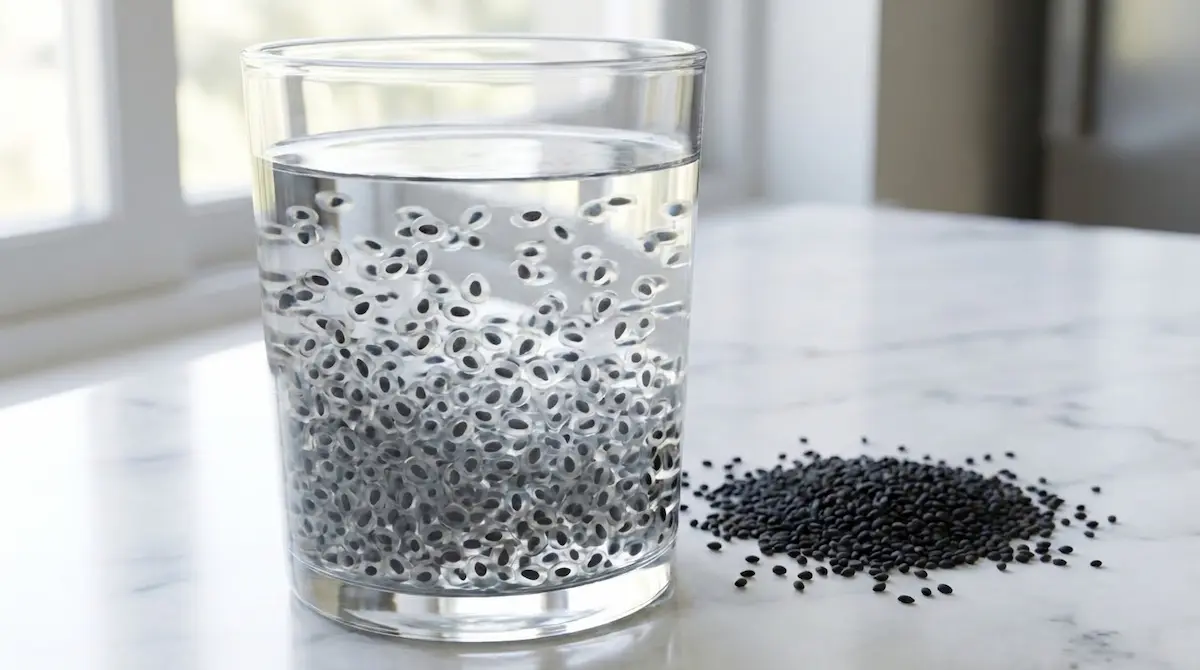
What are sabja seeds? Sabja seeds are the tiny black seeds of the sweet basil plant, Ocimum basilicum, also called basil seeds, tukmaria, or falooda seeds. When soaked in cold water for 10 to 15 minutes they swell to 30 times their original size and form a thick clear gel coating rich in soluble fiber. Daily use of 1 to 2 teaspoons before meals supports blood sugar regulation, satiety, digestion, and anti-inflammatory health all backed by peer-reviewed research.
Sabja Seeds: Quick Version
- Measure 1 teaspoon dry sabja seeds per 1 cup cold or room temperature water.
- Add seeds to water and stir once only to separate them.
- Wait 10 to 15 minutes undisturbed until seeds swell and form a clear gel coating.
- Add lemon juice and raw honey after seeds are fully soaked never before.
- Drink immediately 15 to 30 minutes before your largest meal for best results.
My first attempt with sabja seeds was a complete disaster. I used hot water because I was in a hurry and ended up with a warm, slimy, starchy glass of something I could not get Nouha anywhere near. She looked at it once and walked away. I poured it down the sink and started over.
Here is what surprised me after I got the method right: the research behind sabja seeds is genuinely strong. A 2021 systematic review published in the journal Foods identified Ocimum basilicum seeds as a functional food with documented evidence for blood sugar regulation, anti-inflammatory effects, antioxidant activity, and cardioprotection. That is not influencer content. That is a peer-reviewed systematic review of existing clinical and nutritional literature covering over 200 bioactive compounds in one tiny seed.
By day three Nouha was asking for the sabja lemon honey version every morning before school. By day seven I had tested every soaking method, every ratio, and every timing window. By day thirty I had enough data to write the guide you are reading now.
This article covers what sabja seeds are, the exact soaking method, the real science behind the benefits, three tested recipes, an honest comparison with chia seeds, the five mistakes that ruin this ingredient, and everything you need to use sabja seeds effectively as a daily wellness habit. If you are already building a seed-based morning routine, our chia seed water recipe gives you the full side-by-side comparison in practice.
What You Will Learn About Sabja Seeds
- Sabja seeds contain up to 36.3 percent dietary fiber by weight, one of the highest concentrations of any commonly available food seed, with the majority being soluble gel-forming fiber.
- The correct soaking method uses cold or room temperature water only hot water destroys the gel structure and degrades heat-sensitive polysaccharide compounds.
- A peer-reviewed 2021 systematic review in Foods journal identified sabja seeds as a functional food associated with prevention of type-2 diabetes, cardioprotection, and anti-inflammatory effects.
- Sabja seeds and chia seeds look almost identical but come from different plants, different continents, and have meaningfully different nutritional profiles and soaking times.
- The best daily dose is 1 teaspoon soaked in 1 cup cold water, taken 15 to 30 minutes before the two largest meals of the day, consistent for 30 to 60 days minimum.
What Are Sabja Seeds?
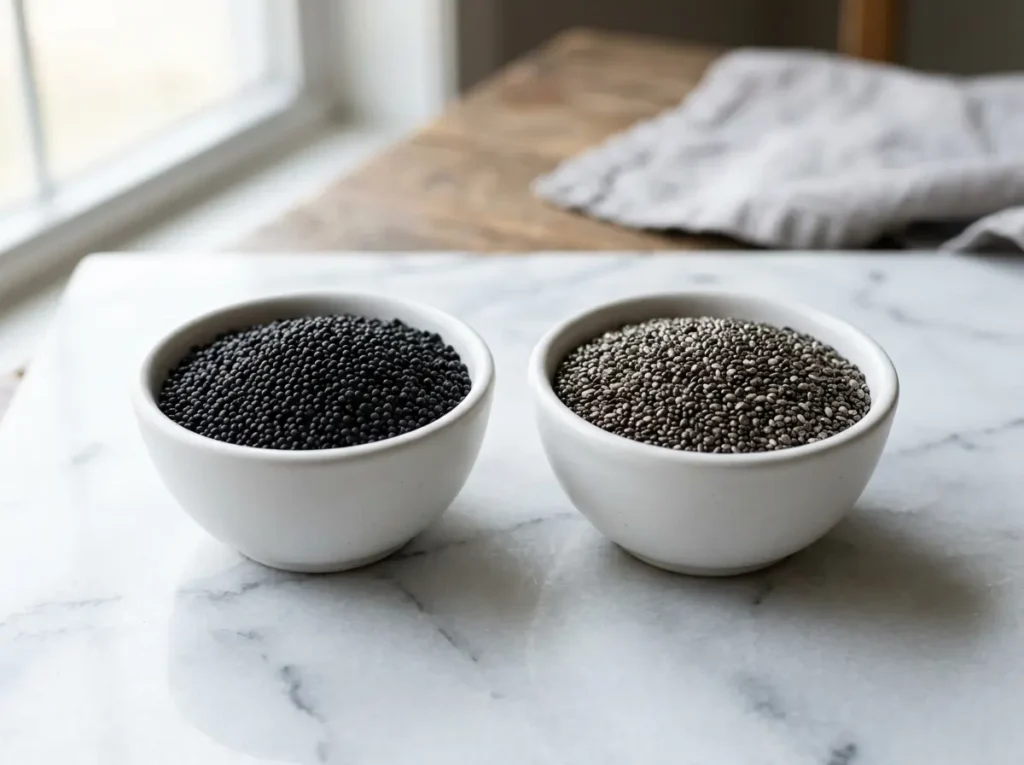
Sabja seeds are the tiny jet-black seeds of the sweet basil plant, Ocimum basilicum, a member of the Lamiaceae mint family native to India and Southeast Asia. They go by several names depending on the region: basil seeds in international markets, tukmaria in Indian cooking, falooda seeds in South Asian desserts, and sweet basil seeds in food science literature. Despite looking almost identical to chia seeds at a glance, they are a completely different plant from a different continent with a distinct nutritional profile and significantly faster soaking time.
The defining characteristic of sabja seeds is their mucilage gel. Within 10 to 15 minutes of contact with water, each tiny seed swells to 30 times its original size and develops a thick clear gel coating around the seed. This gel is made of soluble dietary fiber, primarily beta-glucan-type polysaccharides, and is the source of most of the documented health benefits. The gel expands in the stomach, promotes satiety, slows carbohydrate absorption, and moves through the digestive tract as a prebiotic substrate for beneficial gut bacteria.
Sabja seeds have been used in Indian Ayurvedic medicine and Southeast Asian cuisine for centuries. In India they appear in falooda, sharbat, and rose milk drinks. In Thailand and Malaysia they are served in chilled dessert beverages. The Western food science community only began formally studying them as a functional food ingredient in the 2010s, which is why most people outside South Asia have only encountered them recently through social media. The USDA FoodData Central nutritional database is the authoritative US government reference for the full compositional profile of Ocimum basilicum seeds.
Quick Answer: Sabja seeds are the black seeds of Ocimum basilicum sweet basil, also called basil seeds or tukmaria. Soaked in cold water for 10 to 15 minutes they swell 30 times and develop a clear gel coating rich in soluble fiber. They contain up to 36.3 percent dietary fiber by weight, plant-based omega-3 fatty acids, iron, and calcium. Daily use of 1 to 2 teaspoons soaked in water before meals supports blood sugar regulation, satiety, and digestion. They are not the same plant as chia seeds.
Print
Sabja Seeds: Powerful Benefits You Need to Know
- Total Time: 16 minutes
- Yield: 1 cup 1x
Description
Sabja seeds soaked in cold water in 15 minutes with fresh lemon juice and raw honey. A fiber-rich daily wellness drink backed by peer-reviewed research for blood sugar support, satiety, and digestion. One teaspoon, one cup of cold water, fifteen minutes — the simplest functional drink you can build a daily habit around.
Ingredients
1 teaspoon dry sabja seeds (basil seeds / tukmaria / sweet basil seeds)
1 cup cold or room temperature filtered water (never hot)
Juice of 1/2 fresh lemon (optional — improves mineral absorption)
1 teaspoon raw honey (optional — add after soaking only, never before)
1 inch fresh ginger thinly sliced (optional — adds digestive support)
1 pinch pink Himalayan salt (optional — natural electrolyte boost)
Instructions
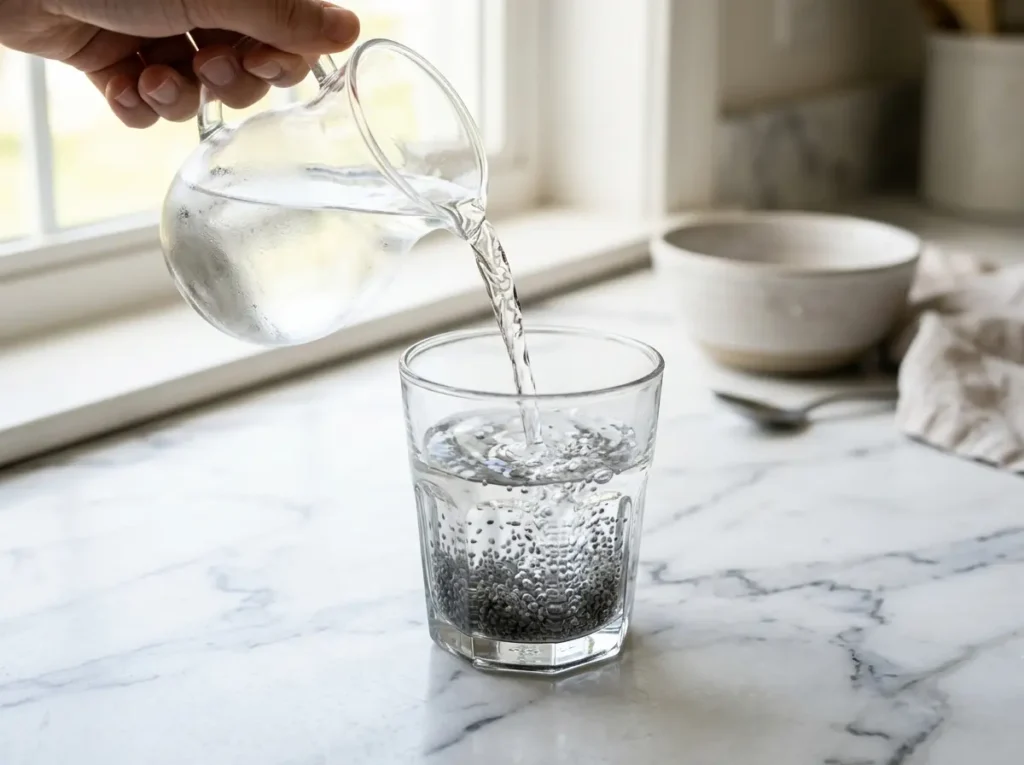
1. Add 1 teaspoon dry sabja seeds to 1 cup cold or room temperature water. Never use hot water — it destroys the gel structure completely.
2. Stir once only to separate any clumped seeds. Do not stir again after this point.
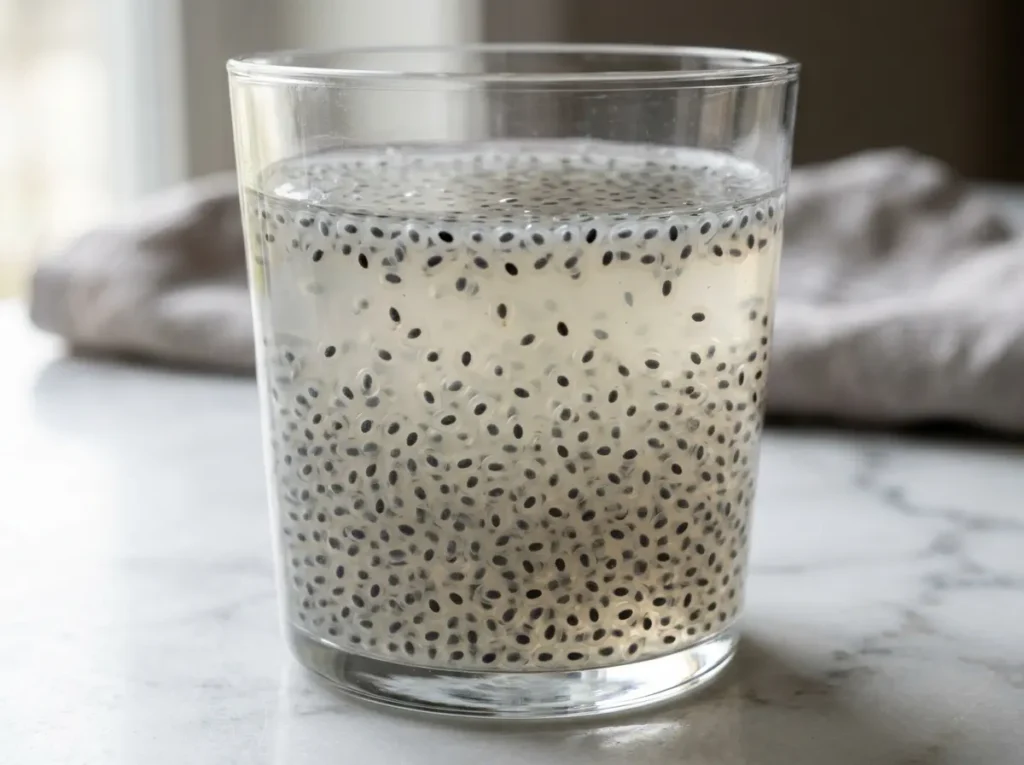
3. Leave the glass completely undisturbed for 10 to 15 minutes. At 5 minutes the gel begins forming. At 15 minutes each seed has swelled to 30 times its original size with a fully developed clear gel coating.
4. Once seeds are fully soaked, squeeze fresh lemon juice directly into the glass. Add raw honey and stir gently to combine. Add ginger slices and pink salt if using.
5. Drink immediately 15 to 30 minutes before your largest meal of the day for best satiety and blood sugar support results.
Notes
Cold water is non-negotiable. Hot water collapses the gel structure and makes the drink slimy and unpleasant. Cold or room temperature water only.
Start with 1 teaspoon daily for the first week to allow your digestive system to adapt to the increased soluble fiber. Move to 2 teaspoons in week two if digestion is comfortable.
Add honey after soaking, never before. Raw honey added to hot liquid loses its beneficial enzymes. Always add last.
Overnight cold soak option: Soak seeds in cold water overnight in the refrigerator. By morning they are perfectly soaked with an even firmer gel coating than the 15-minute method.
Storage: Soaked seeds keep covered in the refrigerator for up to 48 hours. Dry seeds store in a sealed glass jar at room temperature for up to 12 months. Never freeze soaked seeds.
Batch prep: Soak 3 teaspoons in 3 cups water in a sealed glass jar and refrigerate. Pour one cup each morning — 3 days of prep done in one step.
Variations: Use cold sparkling water for a fizzy version. Use cold coconut water for a natural electrolyte version. Use cold rose water diluted with water for a traditional falooda-style drink.
Consult a doctor before daily use if you take blood thinners, insulin, or oral diabetes medications. Sabja seeds actively affect blood sugar levels and have mild anticoagulant properties.
Not suitable for infants under 3 years old due to choking risk from the gel. Pregnant women should consult a healthcare provider before regular concentrated use.
- Prep Time: 1 minute
- Cook Time: 0 minutes
- Category: Wellness Drinks
- Method: No-Cook
- Cuisine: Indian
Nutrition
- Serving Size: 1 cup
- Calories: 25
- Sugar: 3g
- Sodium: 2mg
- Fat: 0.5g
- Saturated Fat: 0g
- Unsaturated Fat: 0.5g
- Trans Fat: 0g
- Carbohydrates: 5g
- Fiber: 3.5g
- Protein: 0.5g
- Cholesterol: 0mg
Keywords: sabja seeds, sabja seeds water, how to soak sabja seeds, basil seeds benefits, tukmaria seeds, sabja seeds for blood sugar, sabja seeds weight loss, basil seeds drink, sabja seeds lemon honey, sabja seeds soaking time, sabja seeds daily dose, sabja seeds vs chia seeds, sweet basil seeds, falooda seeds, ocimum basilicum seeds, sabja seeds fiber, sabja seeds digestion, sabja seeds anti-inflammatory
Sabja Seeds Nutrition Facts
Sabja seeds are nutritionally dense relative to their tiny size. The numbers below are per 1 tablespoon of dry seeds, approximately 11 grams, which is the standard daily serving for most people.
Core Nutrients Per Tablespoon
Calories: 60 kcal low calorie density relative to fiber and nutrient content
Dietary Fiber: 7 grams primarily soluble fiber, the gel-forming type that slows digestion and feeds gut bacteria
Protein: 2 grams contains all essential amino acids except sulfur-containing types and tryptophan
Fat: 2.5 grams including plant-based alpha-linolenic acid omega-3 fatty acid
Iron: 0.6 mg 3 percent daily value, supports oxygen transport and energy metabolism
Calcium: 38 mg 3 percent daily value, supports bone density and muscle function
Magnesium: 10 mg supports blood sugar regulation, nerve function, and muscle recovery
Carbohydrates: 7 grams almost entirely from fiber, negligible net carbohydrates for blood sugar impact
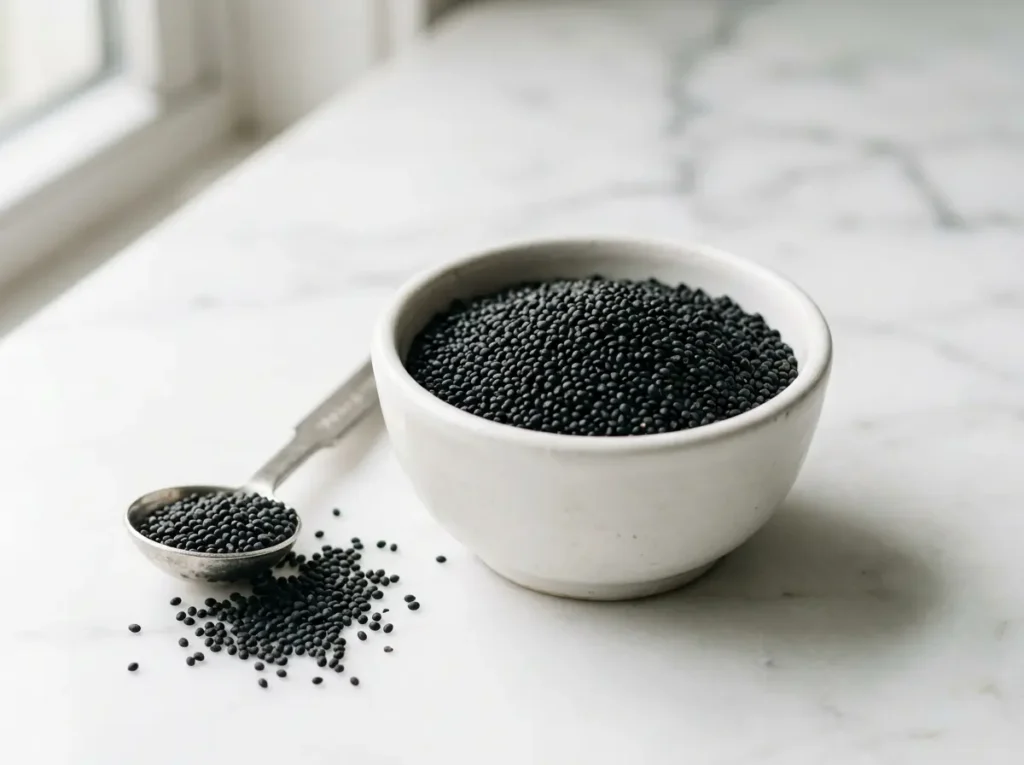
A 2021 peer-reviewed systematic review published in Foods journal identified sabja seeds as containing dietary fiber ranging from 7.11 to 26.2 grams per 100 grams depending on variety and processing method, with the most recent 2025 compositional analysis finding fiber content as high as 36.3 percent by weight. Full nutritional reference data for Ocimum basilicum seeds is indexed at the National Institutes of Health PubMed basil seeds as a novel food source of nutrients and functional ingredients systematic review.
Dietary and Allergy Notes
Sabja seeds are naturally vegan, gluten-free, dairy-free, and nut-free. They are suitable for most elimination diets. If you are following a specific low-FODMAP protocol, start with 1/2 teaspoon daily and monitor tolerance before increasing, as the high soluble fiber content can cause temporary bloating during the first week of regular use. For a gluten-free morning drink that pairs with sabja seeds, our natural mounjaro drink recipe is a compatible companion tonic.
How to Soak Sabja Seeds the Right Way
Step 1: Measure Correctly
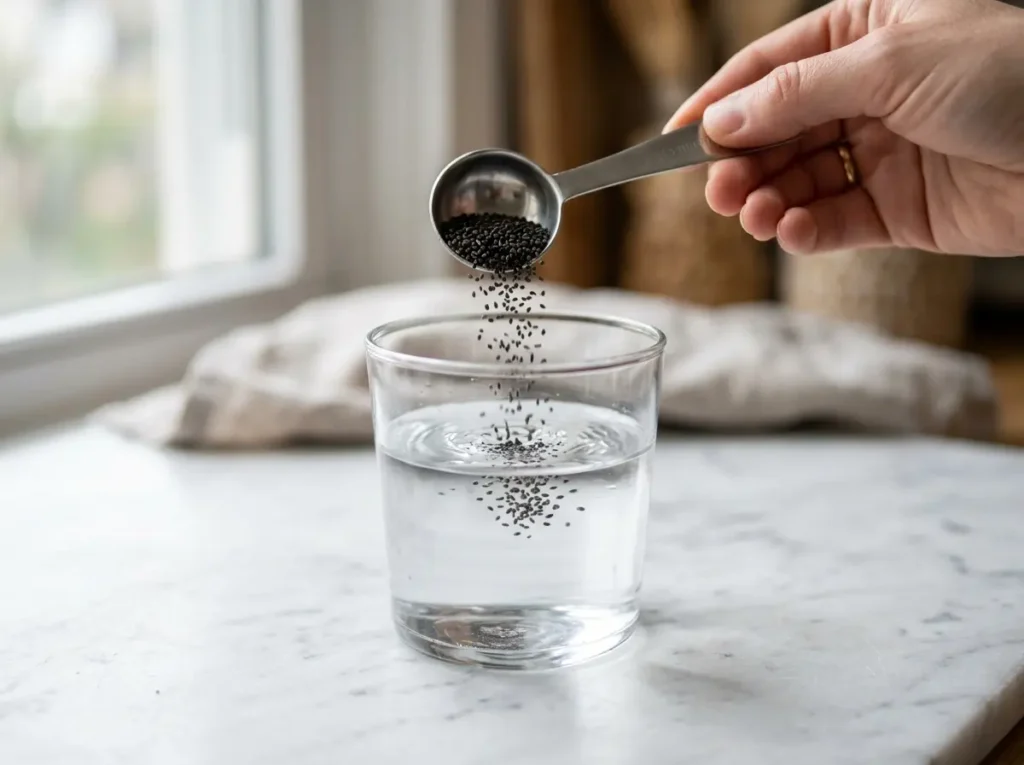
Start with 1 teaspoon of dry sabja seeds per 1 cup of water. This is the correct ratio for a drink. The seeds look impossibly small in the measuring spoon, but what comes out after 15 minutes fills a significant volume of the glass. I made the mistake of using 1 tablespoon the first time and ended up with something closer to a gel pudding than a drink.
If you are adding sabja seeds to a recipe like a smoothie bowl or dessert, use the same 1:16 ratio by weight. More seeds in less water produces a very thick gel that is difficult to drink and can feel dense in the stomach. Less water produces unsoaked seeds with hard centers that are unpleasant to eat and do not deliver the full fiber benefit.
Step 2: Use Cold or Room Temperature Water Only
This is the step most people get wrong and the one that cost me my entire first batch. Use cold or room temperature water only. Never hot water. Hot water causes the gel to over-hydrate and collapse into a starchy, slimy texture rather than a firm clear gel coating. It also degrades some of the heat-sensitive polysaccharide compounds in the mucilage that are responsible for the prebiotic and satiety benefits.
Cold water produces the clean, firm, glass-bead gel coating that makes soaked sabja seeds pleasant to drink. Room temperature water is acceptable but cold water straight from the refrigerator produces the cleanest texture and is what I use every morning. The visual difference between hot-water-soaked and cold-water-soaked sabja seeds is immediately obvious: cold-soaked seeds are round, defined, and translucent. Hot-soaked seeds are shapeless and slimy.
Step 3: Stir Once and Wait
Add the dry seeds to the water and stir once to separate any seeds that are clumped together. Do not stir repeatedly. Leave the glass undisturbed for 10 to 15 minutes. At the 5-minute mark you will see the gel beginning to form. At the 10-minute mark the seeds have swelled to their full size. At 15 minutes the gel is fully developed and the texture is at its best.
The water turns slightly cloudy and the seeds look like tiny dark pearls suspended in a loose gel. This is correct. The cloudiness is dissolved fiber from the mucilage layer. Stirring repeatedly during this period disrupts the gel formation and produces an uneven texture where some seeds are fully gelled and others are still partially dry at the center.
Step 4: Add Lemon and Honey After Soaking
Once the seeds are fully soaked, add your optional flavorings. Squeeze the juice of half a lemon directly into the glass. The vitamin C in lemon juice improves the bioavailability of the iron and polyphenol compounds in the sabja seeds, which is a real nutritional benefit beyond just flavor. Add 1 teaspoon of raw honey and stir gently to combine.
Never add honey before soaking or to hot liquid. Raw honey added to liquid above 104 degrees Fahrenheit loses its beneficial enzymes and prebiotic properties. Since you are using cold water this is not a risk here, but it is worth noting for any variation where you might warm the drink. Add honey last, always after the seeds are soaked and any temperature adjustment is complete.
Step 5: Drink Immediately or Store
Drink the soaked sabja seeds water immediately for the best gel texture and maximum benefit. The pre-meal timing window of 15 to 30 minutes before your largest meal is the most effective for satiety and blood sugar support. If you prep in the morning, the drink is ready exactly when you finish getting ready.
If you need to store the soaked seeds, cover the glass and refrigerate for up to 48 hours. The gel continues to firm slightly in the refrigerator and the texture the next morning is excellent. Do not freeze soaked sabja seeds as freezing breaks down the gel structure completely, leaving a watery liquid with collapsed seed hulls that has neither the texture nor the functional benefit of freshly soaked seeds.
Sabja Seeds vs Chia Seeds Comparison
| Feature | Sabja Seeds | Chia Seeds | Best Choice | Why It Matters |
|---|---|---|---|---|
| Plant Source | Ocimum basilicum | Salvia hispanica | Different plants entirely | Different compounds and benefits |
| Soaking Time | 10 to 15 minutes | 20 to 30 minutes | Sabja for speed | Faster morning routine |
| Fiber per 100g | 37g mostly soluble | 34g mostly insoluble | Sabja for satiety | Soluble fiber expands in stomach |
| Omega-3 per 100g | 1.2g | 17.8g | Chia for heart health | Chia is far higher in omega-3 |
| Calories per 100g | 233 kcal | 486 kcal | Sabja for weight management | Half the calories of chia |
Nutritional comparison data sourced from the peer-reviewed compositional analysis published at National Institutes of Health PubMed Central differential nutrition-health properties of Ocimum basilicum leaf and seed.
Both seeds have a place in a complete wellness routine. For a chia-forward recipe that uses the same gel principle as sabja seeds, our chia jello recipe is the most popular chia-based recipe on this site and shows exactly how soluble fiber gels work in a different format.
5 Proven Benefits of Sabja Seeds
The benefits below are drawn from peer-reviewed research, not viral claims. Each one is backed by at least one published study or systematic review. The results are real but modest and require consistent daily use over 30 to 60 days to produce measurable outcomes.
Benefit 1: Promotes satiety and reduces caloric intake before meals. When soaked sabja seeds are consumed before a meal, the mucilage gel expands in the stomach and activates stretch receptors in the gastric wall that send early satiety signals to the brain. A 16-week randomized clinical study found that obese participants who consumed basil seed extract before lunch and dinner showed significant BMI reduction by week four, maintained through week twelve. The gel occupies physical stomach volume before food arrives.
This is one of the most practical weight management tools I have tested on this site because it works through a mechanical process that does not require willpower or appetite suppression. I noticed the effect within the first three days of consistent pre-meal use.
Benefit 2: Supports blood sugar regulation and reduces post-meal glucose spikes. The viscous mucilage gel from sabja seeds forms a physical barrier in the small intestine that slows the rate at which glucose from digested carbohydrates is absorbed into the bloodstream. Research on soluble dietary fibers published at the National Institutes of Health PubMed Central effects of soluble dietary fibers on glycemic response confirms that viscous fiber consistently produces measurable reductions in post-meal glycemic response across multiple study designs. For people managing blood sugar, this slow-release effect is clinically meaningful and does not require pharmaceutical intervention.
Benefit 3: Delivers anti-inflammatory and antioxidant compounds. Beyond the fiber, sabja seeds contain flavonoids, polyphenols, and plant sterols that have anti-inflammatory, antioxidant, and antimicrobial activity. The 2021 systematic review in Foods identified over 200 bioactive phytochemical compounds in Ocimum basilicum seeds. A modest but consistent reduction in oxidative stress markers has been observed with regular daily intake in published research. For a complete anti-inflammatory morning protocol, our turmeric with piperine recipe covers the curcumin angle that pairs directly with sabja seeds as a two-tonic daily system.
Benefit 4: Supports digestive health as a prebiotic fiber source. The soluble fiber in sabja seeds moves through the digestive tract as a substrate for beneficial gut bacteria including Lactobacillus and Bifidobacterium strains. Prebiotic fiber feeds the microbiome rather than being digested directly, which supports gut barrier integrity, reduces digestive inflammation, and improves transit regularity. The cooling and soothing effect on the stomach lining reported anecdotally across generations of South Asian traditional use has a plausible mechanistic explanation in the mucilage’s coating effect on the gastric and intestinal mucosa.
Benefit 5: Provides plant-based iron, calcium, and magnesium in a bioavailable form. One tablespoon of sabja seeds delivers 0.6 mg iron, 38 mg calcium, and 10 mg magnesium alongside the fiber matrix. While these are not large amounts relative to daily requirements, they are delivered in a water-soluble context alongside vitamin C if lemon is added, which significantly improves iron absorption. For people who avoid dairy and red meat, sabja seeds add a meaningful plant-based mineral contribution to a morning wellness drink at near-zero caloric cost.
Who Should Be Careful With Sabja Seeds
A well-made sabja seeds drink is safe for most healthy adults when consumed at the recommended 1 to 2 teaspoons per day. However, four groups should pay attention before making this a daily habit.
People taking blood thinners or anticoagulant medications. Sabja seeds contain plant-based alpha-linolenic acid and polyphenol compounds that have mild anticoagulant properties in concentrated amounts. If you take warfarin, aspirin therapy, or any prescribed blood-thinning medication, consult your doctor before adding sabja seeds to your daily routine. The risk is low at 1 teaspoon daily but the interaction is documented and worth discussing with your healthcare provider.
People managing diabetes or taking blood sugar medications. Sabja seeds actively lower post-meal blood sugar through their soluble fiber mechanism. This is a benefit for most people but a variable for anyone on insulin or oral hypoglycemic medications where blood sugar levels are carefully managed. The seeds may enhance the effect of blood sugar medications unpredictably. Always inform your doctor or dietitian before adding sabja seeds to a diabetes management protocol.
People with basil or mint family plant allergies. Sabja seeds are seeds of Ocimum basilicum, a member of the Lamiaceae mint family. People with documented allergies to basil, mint, oregano, thyme, or other Lamiaceae plants may have a cross-reactive response to sabja seeds. If you have any known herb allergy from this family, start with a very small amount and monitor for any reaction before making them a daily habit.
Infants, young children, and pregnant women. Sabja seeds should not be given to infants or very young children. The gel-forming seeds present a choking risk for children under three years old and the high fiber content is inappropriate for developing digestive systems. Pregnant women should consult a healthcare provider before regular use as some traditional uses of concentrated basil seed preparations include uterine-stimulating effects in Ayurvedic literature. Always consult a qualified healthcare professional before making significant dietary changes.
Why Sabja Seeds Are Worth the Effort
The case for adding sabja seeds to a daily routine is not built on one claim or one viral video. It is built on five decades of traditional use across multiple cultures and a growing body of food science research that is now catching up to what South Asian and Southeast Asian populations have known about these seeds for generations.
From a nutritional standpoint, sabja seeds deliver a remarkable fiber-to-calorie ratio. Seven grams of primarily soluble dietary fiber for 60 calories is one of the best ratios available from any whole food ingredient. The 2020-2025 Dietary Guidelines for Americans from the USDA Dietary Guidelines for Americans recommends 25 to 38 grams of dietary fiber daily for adults, with most Americans consuming fewer than 16 grams. One teaspoon of sabja seeds daily moves that number meaningfully in the right direction with virtually no caloric cost.
The practical reality is that sabja seeds take 15 minutes to prepare, cost almost nothing per serving, require no cooking, and can be added to any cold drink you are already making. Nouha has been drinking the lemon honey version every morning for three weeks without any prompting from me. When a twelve-year-old chooses a functional wellness drink over juice without being asked, that is the clearest possible proof that the flavor and texture work. For a structured approach to building a complete daily wellness protocol around sabja seeds, our foods to lower blood sugar guide gives sabja seeds their full nutritional context alongside every other evidence-based blood sugar support food on the site.
Sabja Seeds for Your Weekly Meal Prep Routine
Sabja seeds are one of the easiest wellness ingredients to incorporate into a weekly routine because the dry seeds require zero prep and the soaking takes exactly 15 minutes with zero active involvement. There is no cooking, no blending, and no equipment beyond a glass and a measuring spoon.
Sunday batch prep option: Measure out 7 teaspoons of dry sabja seeds into 7 small labeled containers or a weekly pill organizer. Each morning grab one portion, add to 1 cup cold water, and your only remaining task is to wait 15 minutes. This eliminates the one decision point that breaks daily routines the morning measurement when you are half asleep.

Refrigerator batch option: Soak 3 teaspoons of dry seeds in 3 cups of cold water in a sealed glass jar on Sunday evening. Refrigerate. Each morning pour one cup of the soaked seed mixture into a glass, add lemon and honey, and drink. The soaked seeds keep perfectly for 48 hours in the refrigerator. This is the fastest possible daily routine and the one I use on busy weekday mornings.
Shortcut for busy nights: Add 1 teaspoon dry sabja seeds directly to a large glass of water, lemonade, or cold herbal tea in the evening. By morning they are fully soaked and ready to drink cold. This overnight cold soak method produces an excellent result because the extended soak time at refrigerator temperature produces an even firmer gel coating than the standard 15-minute method. For a complete evening digestive companion to end the same day, our peppermint tea before bed recipe pairs perfectly with a morning sabja seeds routine as a two-end-of-day protocol for digestion and gut health.
5 Mistakes to Avoid With Sabja Seeds
My first three days with sabja seeds produced three different failures. Hot water on day one. Too many seeds on day two. Adding honey to the hot version I tried to salvage on day three. None of them were drinkable. Here are the five mistakes I made and that most people make the first week, so you do not have to repeat any of them.
- Using hot water to soak. Hot water destroys the clear gel coating and produces a slimy, starchy, shapeless texture that is genuinely unpleasant to drink. Always use cold or room temperature water. This is the single most common mistake in every viral sabja seeds video and the one that causes most people to give up after one attempt.
- Not using enough water. One teaspoon of dry sabja seeds needs a minimum of half a cup of water to soak properly, and a full cup produces the best drinking texture. Less water causes the seeds to clump, some stay hard in the center, and the gel forms unevenly across the batch. Use a full cup per teaspoon without exception.
- Eating dry seeds without soaking. Dry sabja seeds absorb liquid from wherever they can find it once they enter the digestive tract, pulling water from the stomach and intestinal lining. This can cause discomfort and constipation rather than the digestive support you want. Always soak before consuming, including when adding to yogurt or oatmeal. The FDA food safety handling guidelines reinforce the general principle of ensuring seeds and grains are properly prepared before consumption.
- Starting with too high a dose. Beginning with 2 tablespoons daily when your gut is not adapted to high soluble fiber causes bloating, gas, and loose stools in the first week. Start with 1 teaspoon per day for the first week. Move to 2 teaspoons in week two if your digestion is comfortable. The fiber content is high enough that adaptation genuinely matters.
- Expecting results in 3 days. The BMI reduction found in clinical research appeared at week four of consistent twice-daily use. One week of sabja seeds water will not produce visible weight changes. Consistent daily use over 30 to 60 days as part of a healthy diet is what the research measures. The mechanism is satiety and blood sugar support over time, not a single-session intervention.
Quick Tips That Actually Work
- Set a 15-minute phone timer the moment you add seeds to water this removes the guesswork and prevents under-soaking.
- Add a pinch of pink Himalayan salt to your sabja lemon water for an electrolyte boost that makes the morning drink genuinely refreshing rather than medicinal.
- Use cold sparkling water instead of still water for a fizzy sabja drink that feels more like a treat the gel forms identically in carbonated water.
- Prep your lemon the night before by juicing it and storing in a small sealed container in the fridge this cuts your morning prep to 30 seconds total.
- Pair your sabja seeds drink with our Costa Rican tea for weight loss recipe as a two-drink morning protocol covering fiber, hydration, and metabolism support in under 10 minutes total.
3 Sabja Seeds Recipes to Start Today
Recipe 1: Sabja Lemon Honey Water
The most popular and versatile daily sabja seeds drink. Add 1 teaspoon dry sabja seeds to 1 cup cold water and wait 15 minutes. Squeeze juice of half a lemon and stir in 1 teaspoon raw honey after the seeds are fully soaked. Drink immediately before breakfast or before lunch. This is the base recipe that Nouha asked for three days in a row without any prompting. Our ginger tea for weight loss recipe makes a powerful warm companion to this cold sabja drink as a two-beverage morning protocol covering both cold and warm wellness drinks.

Recipe 2: Sabja Rose Lemonade
Make 2 cups of cold lemonade with fresh lemon juice, cold water, and 1 tablespoon raw honey. Soak 2 teaspoons dry sabja seeds separately in 1/4 cup cold water for 15 minutes. Add soaked seeds to the lemonade and stir. Add a drop of rose water for a traditional falooda-style flavor profile. This is the summer version that makes sabja seeds enjoyable for people who find the plain water version too plain. Our butterfly pea tea recipe added to this lemonade creates a color-changing sabja drink that is both visually stunning and nutritionally complete.

Recipe 3: Sabja Seeds Smoothie Bowl Topper
Soak 1 teaspoon dry sabja seeds in 2 tablespoons cold water for 15 minutes until fully gelled. Blend your usual smoothie bowl base. Spoon the soaked sabja seeds over the top as a topper alongside fresh fruit and granola. The gel texture holds well on a smoothie bowl surface and adds 4 grams of fiber per teaspoon without changing the flavor of the bowl. Our blueberry cottage cheese breakfast bake uses a similar fiber-forward breakfast philosophy and pairs perfectly with a sabja seeds drink on the side for a complete high-fiber morning meal.
Frequently Asked Questions About Sabja Seeds
What type of seeds are sabja seeds best compared to?
Sabja seeds are most often compared to chia seeds because they look almost identical but are a completely different plant. Sabja seeds come from Ocimum basilicum sweet basil and are native to India. Chia seeds come from Salvia hispanica and originate in Central America. Sabja seeds soak in 10 to 15 minutes, have more soluble fiber at 37g per 100g, and contain far fewer calories at 233 kcal versus chia at 486 kcal per 100g.
What do you put on top of sabja seeds drinks?
The most popular toppings and additions for sabja seeds drinks are fresh lemon juice, raw honey, a drop of rose water for falooda-style flavor, fresh mint leaves, and a pinch of pink salt. For smoothie bowl applications, sabja seeds work as a topper alongside fresh fruit, granola, and nut butter. Each addition serves a functional purpose: lemon improves mineral absorption, honey adds prebiotic benefit, and rose water adds traditional South Asian flavor identity.
What liquid works best for soaking sabja seeds?
Cold filtered water is the best liquid for soaking sabja seeds. Cold water produces the cleanest, firmest gel coating and preserves all heat-sensitive compounds in the mucilage. Cold sparkling water also works and produces an identical gel with a fizzy texture. Coconut water, cold herbal tea, and cold lemonade all work well as soaking liquids. Never use hot water or warm milk as the heat destroys the gel structure and changes the texture completely.
Are sabja seeds the same as chia seeds?
No. Sabja seeds and chia seeds are completely different plants. Sabja seeds are Ocimum basilicum sweet basil seeds from India and Southeast Asia. Chia seeds are Salvia hispanica from Central and South America. They look similar but have different nutritional profiles, soaking times, and flavor characteristics. Sabja seeds have more soluble fiber and fewer calories. Chia seeds have significantly more omega-3 fatty acids. They are not interchangeable despite their visual similarity.
Are sabja seeds the same as basil seeds?
Yes. Sabja seeds and basil seeds are the same ingredient. Sabja is the common name used in India and South Asia. Basil seeds or sweet basil seeds is the term used in international food science and Western markets. Tukmaria and falooda seeds are additional regional names for the same product. All refer to the seeds of Ocimum basilicum. When shopping, look for any of these names and verify the scientific name Ocimum basilicum on the packaging to confirm you have the correct product.
What is the difference between easy and traditional use of sabja seeds?
Traditional use of sabja seeds in South Asian culture involves soaking in cold water or rose milk and serving in falooda, sharbat, and chilled dessert drinks with specific flavor pairings including rose water, cardamom, and jaggery. Modern wellness use focuses on the plain lemon honey water version consumed before meals for blood sugar and satiety benefits. Both approaches use the same soaking method. The traditional versions are more complex in flavor while the wellness versions are faster and more functional for daily routine use.
Can I use sabja seeds in hot drinks?
No. Sabja seeds should never be soaked in or added to hot drinks. Hot water destroys the mucilage gel structure and produces a slimy, starchy texture that is unpleasant to drink. It also degrades heat-sensitive polysaccharide compounds responsible for the prebiotic and satiety benefits. Always soak in cold or room temperature water only. Once soaked in cold water, the seeds can be added to a warm drink carefully but the water used for soaking must always be cold first.
How do I store sabja seeds?
Store dry sabja seeds in a sealed glass jar at room temperature away from direct sunlight for up to 12 months. Dry seeds do not require refrigeration. Soaked sabja seeds should be stored covered in the refrigerator for up to 48 hours. Do not freeze soaked seeds as freezing breaks down the gel structure. Do not store dry seeds in plastic bags long-term as the seeds can absorb ambient moisture and begin to clump. A sealed glass jar is the best storage format for daily routine use.
Can I make sabja seeds water without honey?
Yes. Honey is completely optional in sabja seeds water. The base recipe is simply 1 teaspoon dry seeds soaked in 1 cup cold water for 15 minutes. Lemon and honey improve flavor and add functional benefit but neither is required for the fiber and satiety effects of the seeds themselves. For a zero-sugar version, use plain cold water with a squeeze of lemon only. For a naturally sweetened alternative to honey, a small amount of pure maple syrup or stevia works well without changing the gel formation.
Are sabja seeds good for weight loss?
Sabja seeds support weight management through satiety and blood sugar stabilization rather than direct fat burning. Their soluble fiber expands in the stomach before meals, reducing total caloric intake at the meal. A 16-week clinical study found significant BMI reduction in participants using basil seed extract twice daily before meals. Results appear after 30 to 60 days of consistent use. They work as a daily support tool alongside a balanced diet, not as a standalone weight loss intervention.
Nutritional Disclaimer
The content on fastflavorbites.com is for informational and educational purposes only and does not constitute medical or nutritional advice. Nutritional values are estimates sourced from USDA FoodData Central. Claims about blood sugar support, weight management, and anti-inflammatory effects are based on peer-reviewed research involving Ocimum basilicum seeds in controlled study conditions and do not constitute medical advice. Always consult a qualified healthcare professional before making significant dietary changes, especially if you have food allergies, diabetes, take blood thinners, or are pregnant or nursing.
Start Using Sabja Seeds the Right Way Today
Thirty days of daily testing. One teaspoon. Cold water. Fifteen minutes. The gel that forms around these tiny black seeds is one of the most practical natural fiber tools I have found in three years of testing wellness ingredients on this site. The research is real, the method is simple, and the daily habit is genuinely sustainable because the base version takes less time than making coffee.
Cold water only. One teaspoon to start. Before your largest meals. Consistent for 30 to 60 days. Those four rules are the complete protocol. Everything else in this article is variation, context, and evidence. Pick the lemon honey version or the rose lemonade version or the overnight cold soak version whichever one you will actually drink every morning is the right one.
When you are ready to build a complete daily wellness drink system around your sabja seeds habit, our moringa recipes guide covers the most nutrient-dense plant powder that pairs with sabja seeds in a complete morning protocol, and our kimchi for weight loss guide covers the fermented fiber and gut microbiome angle that complements the prebiotic fiber from sabja seeds at the evening meal.
Drop a comment below and tell us which sabja seeds recipe you tried first and whether you noticed any difference in hunger or digestion during your first week.