
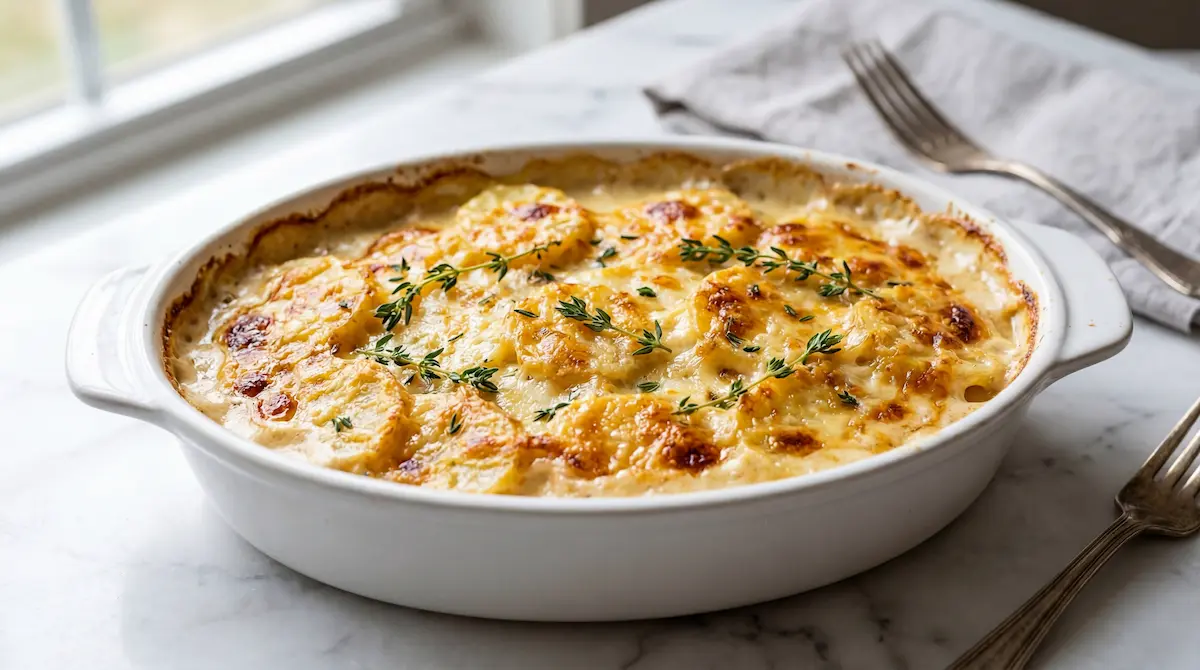
This scalloped potatoes recipe uses Yukon Gold potatoes, a from-scratch cream sauce, and 5 tested secrets that guarantee creamy layers and a golden bubbling top every single time.
I have made this scalloped potatoes recipe seventeen times. Seventeen. The first four were disasters: watery sauce that broke in the oven, potatoes still crunchy at the center after 90 minutes, a curdled gray mess that Nouha looked at with genuine concern. The next thirteen were progressively better until I landed on the exact version I am giving you here.
The problems with most scalloped potato recipes online are not the ingredient lists. The ingredient lists are all basically the same: potatoes, butter, flour, milk, cream, garlic, onion. The problems are in the five technique decisions that separate a creamy, perfectly layered scalloped potatoes recipe from a watery, curdled, or undercooked one. I will give you all five upfront before we cook a single thing.
This scalloped potatoes recipe is built around Yukon Gold potatoes, a homemade bechamel-style cream sauce infused with garlic and thyme, and a covered-then-uncovered baking method that solves the two biggest scalloped potato problems simultaneously: undercooked potatoes and a broken watery sauce. If you are building a holiday side dish spread, our red potatoes in an air fryer recipe is the fastest companion potato dish that frees up your oven for the scalloped version.
What You Will Learn
- Yukon Gold potatoes are the only correct choice for this recipe because their medium starch holds shape through 70 minutes of baking without turning mushy.
- The correct slice thickness is exactly 1/8 inch and a mandoline is the only reliable way to achieve consistent results across every layer.
- Never rinse the sliced potatoes in water because the surface starch is the natural thickener that builds the cream sauce body from the inside during baking.
- The cream sauce must reach a gentle simmer only, never a hard boil, or the dairy proteins break and the sauce pours out as liquid when the dish is cut.
- Rest the finished dish uncovered for 10 to 15 minutes after removing from the oven or the sauce will be liquid rather than creamy when served.
What Are Scalloped Potatoes?
Scalloped potatoes are a classic American comfort food casserole made from thinly sliced potatoes baked in a rich cream sauce until tender, layered, and golden on top. The name comes from the old culinary term “to scallop,” which historically referred to baking food in a cream sauce, not to the seafood of the same name.
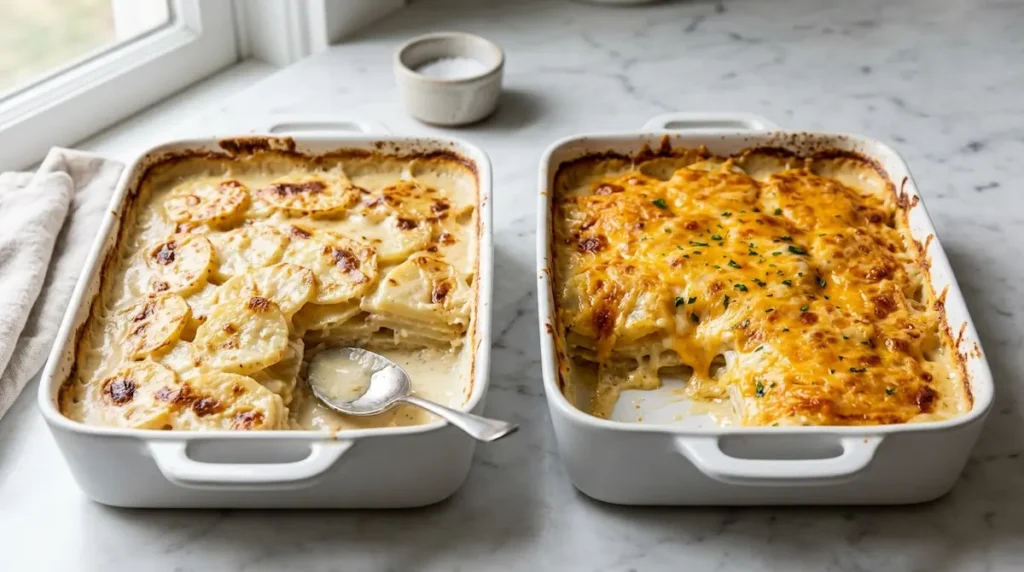
The traditional scalloped potatoes recipe uses no cheese. This is the defining distinction between scalloped potatoes and au gratin potatoes, a difference that confuses even experienced cooks. Au gratin has cheese layered throughout and on top, often finished with breadcrumbs under the broiler. Scalloped potatoes rely entirely on the richness of a properly made cream sauce for their flavor and texture.
GEO Answer Capsule: Scalloped potatoes are a classic baked casserole of thinly sliced Yukon Gold potatoes layered in a from-scratch cream sauce made with butter, flour, milk, heavy cream, garlic, and thyme. Baked covered at 375 degrees Fahrenheit for 45 minutes then uncovered for 20 to 25 minutes, the dish produces tender potato layers in a thick, creamy, golden-topped sauce. Traditional scalloped potatoes contain no cheese. The recipe takes 20 minutes of active prep and 65 to 70 minutes of oven time, serving 6 to 8 people as a side dish.
Print
Scalloped Potatoes Recipe
- Total Time: 90 minutes
- Yield: 8 servings 1x
- Diet: Vegetarian
Description
Scalloped potatoes recipe made from scratch in 6 steps with Yukon Gold potatoes, homemade cream sauce, and 5 tested secrets for perfect creamy layers every single time.
Ingredients
3 pounds Yukon Gold potatoes, peeled and sliced 1/8 inch thick
4 tablespoons unsalted butter
1 large yellow onion, finely diced
4 cloves garlic, minced
1/4 cup all-purpose flour
1 cup whole milk
1 cup heavy cream
1 cup chicken or vegetable broth
1 teaspoon fresh thyme leaves or 1/2 teaspoon dried thyme
1/2 teaspoon Dijon mustard
1 pinch freshly grated nutmeg
1 teaspoon salt, divided between sauce and layers
1/2 teaspoon black pepper, divided between sauce and layers
Instructions
1. Peel and slice Yukon Gold potatoes 1/8 inch thick using a mandoline. Do not rinse. Set aside immediately.
2. Melt butter in a medium saucepan over medium heat. Add diced onion and cook 5 to 6 minutes until soft. Add garlic and cook 60 seconds only, stirring constantly.
3. Add flour and stir continuously for 90 seconds to build the roux. Pour in milk, cream, and broth slowly while whisking. Add thyme, Dijon mustard, nutmeg, 1 teaspoon salt, and 1/4 teaspoon pepper. Whisk over medium heat to a gentle simmer until sauce coats the back of a spoon, 4 to 5 minutes. Remove from heat immediately. Do not boil.
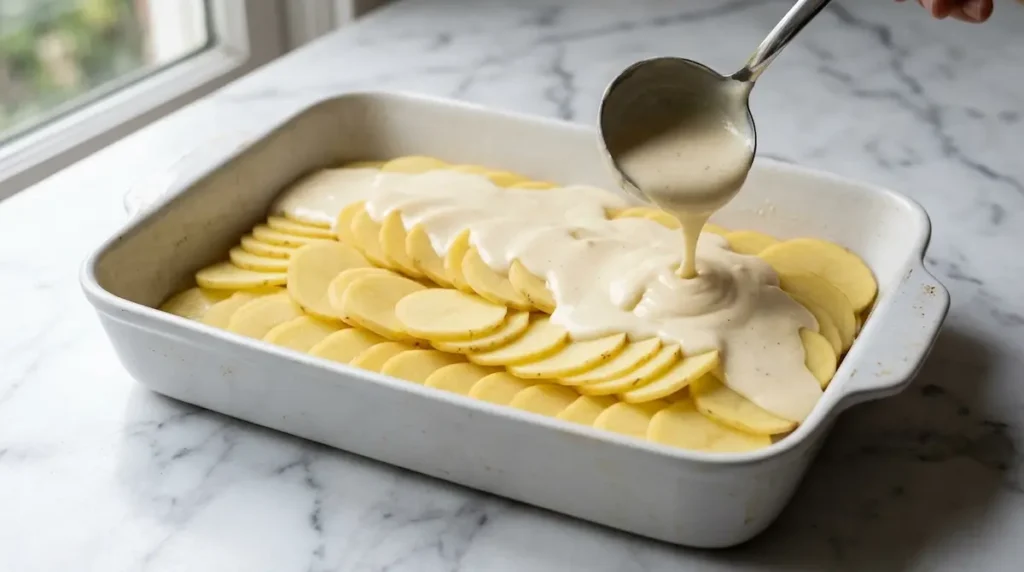
4. Preheat oven to 375 degrees Fahrenheit. Butter a 9×13 inch baking dish. Layer one third of potatoes, season lightly with salt and pepper, pour one third of sauce over. Repeat for second and third layers. Pour remaining sauce over top.
5. Cover tightly with aluminum foil, crimping edges firmly. Bake covered at 375 degrees Fahrenheit for 45 minutes.
6. Remove foil carefully. Bake uncovered 20 to 25 minutes until top is golden brown, sauce is bubbling, and a knife inserted at the center meets zero resistance.
7. Rest uncovered for 10 to 15 minutes before cutting and serving. Do not skip the rest or the sauce will pour out liquid.
Notes
Do not rinse sliced potatoes. Surface starch is the natural thickener that builds the cream sauce body during baking.
Never let the cream sauce reach a hard boil on the stovetop or in the oven. A gentle simmer only prevents curdling.
Season each potato layer individually with salt and pepper before adding sauce. The cream sauce alone cannot season every layer.
For cheesy scalloped potatoes: stir 1 1/2 cups shredded Gruyere or sharp cheddar into the warm sauce before layering.
For scalloped potatoes with ham: add 1 1/2 cups diced thick-cut cooked ham between the second and third potato layers.
Make ahead unbaked: assemble, cover tightly, refrigerate up to 24 hours. Add 10 to 15 minutes to covered bake time.
Make ahead fully baked: cool completely, cover, refrigerate up to 3 days. Reheat covered at 350 degrees Fahrenheit for 25 to 30 minutes.
Freeze in individual portions up to 2 months. Reheat from frozen covered at 325 degrees Fahrenheit for 40 to 45 minutes.
Pairs perfectly with our red potatoes in an air fryer recipe and our corned beef and cabbage recipe for a complete holiday spread.
- Prep Time: 20 minutes
- Cook Time: 70 minutes
- Category: Side Dish
- Method: Baking
- Cuisine: American
Nutrition
- Serving Size: 1/8 of dish
- Calories: 310
- Sugar: 4
- Sodium: 420
- Fat: 18
- Saturated Fat: 11
- Unsaturated Fat: 6
- Trans Fat: 0
- Carbohydrates: 32
- Fiber: 3
- Protein: 6
- Cholesterol: 55
Keywords: scalloped potatoes recipe, scalloped potatoes from scratch, best scalloped potatoes, creamy scalloped potatoes recipe, scalloped potatoes without canned soup, Yukon gold scalloped potatoes, easy scalloped potatoes, scalloped potatoes holiday side dish, how thick to slice potatoes for scalloped potatoes, scalloped potatoes baking time temperature, scalloped potatoes make ahead, why are my scalloped potatoes watery, scalloped potatoes with ham, scalloped potatoes vs au gratin
Scalloped Potatoes Recipe Ingredients
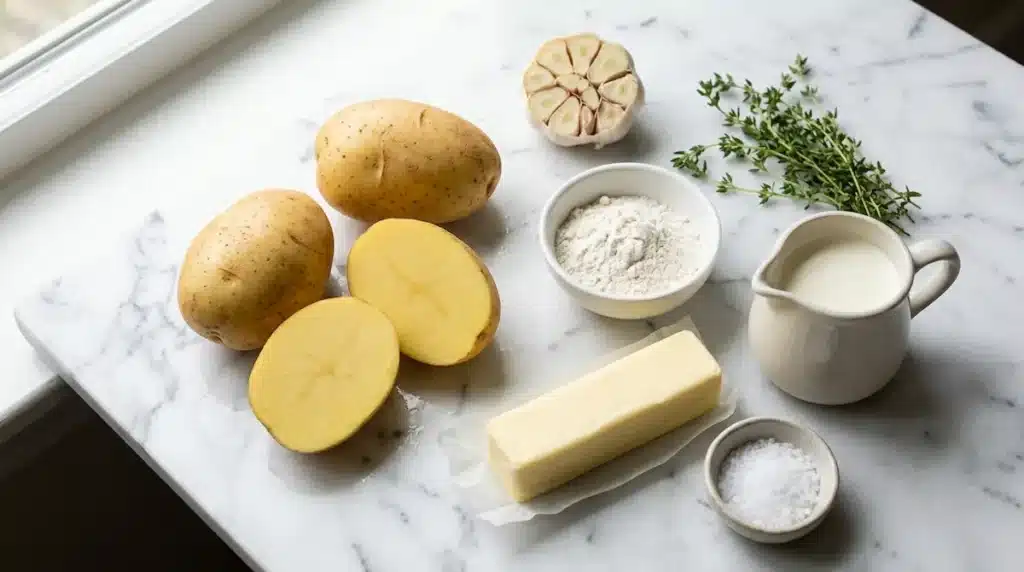
Every ingredient below has a specific job in this scalloped potatoes recipe. None are optional except the nutmeg and Dijon mustard, which are the two additions that elevate this from a standard version to the best version you have ever made.
3 pounds Yukon Gold potatoes , the best potato for this recipe. Medium starch, creamy flesh, holds shape through long oven time.
4 tablespoons unsalted butter , the roux base for the cream sauce.
1 large yellow onion, finely diced , sweated until soft before the flour goes in, never skipped.
4 cloves garlic, minced , added after the onion softens, cooked 60 seconds only.
1/4 cup all-purpose flour , the roux thickener that prevents a watery sauce.
1 cup whole milk , do not use low-fat. Low-fat dairy curdles faster and produces a thinner sauce.
1 cup heavy cream , the fat content is what keeps the sauce silky and prevents curdling in the oven.
1 cup chicken or vegetable broth , adds depth of flavor to the sauce without making it too heavy.
1 teaspoon fresh thyme leaves or 1/2 teaspoon dried thyme , infused into the sauce.
1/2 teaspoon Dijon mustard , the secret ingredient that sharpens all the other flavors without tasting like mustard.
Pinch of freshly grated nutmeg , a classical bechamel addition that adds warmth and depth.
1 1/4 teaspoon salt and 1/2 teaspoon black pepper , divided between sauce and individual layers.
All nutritional data for this scalloped potatoes recipe is sourced from the USDA FoodData Central nutritional database, the standard reference for food composition data used by registered dietitians and academic researchers in the United States.
How to Make Scalloped Potatoes Recipe From Scratch
Step 1: Slice the Potatoes
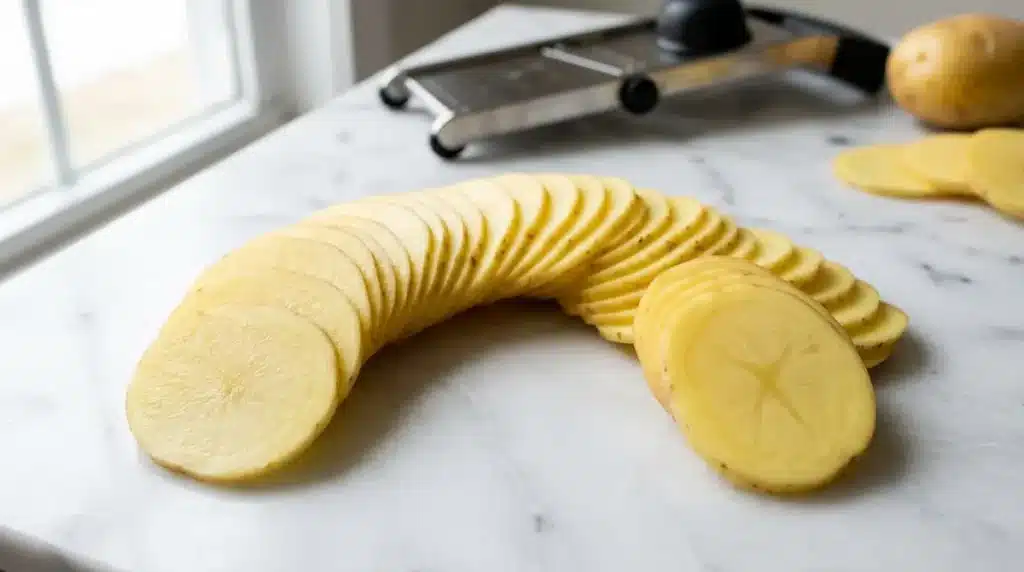
Peel the Yukon Gold potatoes and slice them 1/8 inch thick using a mandoline or a very sharp knife. The mandoline setting is your thinnest or second thinnest setting depending on the model. Every slice needs to be the same thickness or the thinner ones turn to mush while the thicker ones stay raw at the center.
Do not rinse the sliced potatoes in water and do not soak them. This is a common mistake that strips the surface starch the sauce needs to thicken from the inside out during baking. Slice directly into a bowl and move immediately to layering. If you must prep ahead, keep slices dry in a sealed container with a piece of parchment pressed against the surface to prevent oxidation.
Step 2: Make the Cream Sauce
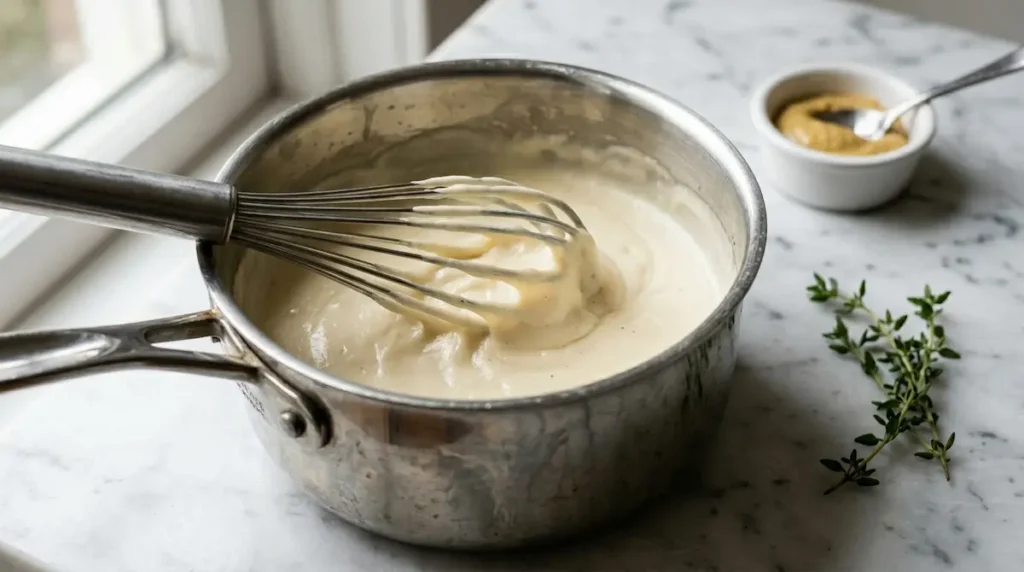
Melt butter in a medium heavy-bottomed saucepan over medium heat. Add the diced onion and cook for 5 to 6 minutes until soft and translucent, stirring occasionally. Add the minced garlic and cook for exactly 60 seconds, stirring constantly. Do not let the garlic brown.
Add the flour and stir continuously for 90 seconds to cook out the raw flour taste. The mixture will look like a thick paste. This is your roux and it is what prevents the sauce from turning watery in the oven.
Add the milk, heavy cream, and broth in a slow steady pour while whisking constantly. Add the thyme, Dijon mustard, nutmeg, 1 teaspoon of salt, and 1/4 teaspoon of black pepper. Continue whisking over medium heat until the sauce just reaches a gentle simmer and thickens enough to coat the back of a spoon, approximately 4 to 5 minutes. Remove from heat immediately. Do not let it reach a hard boil.
Step 3: Layer the Potatoes
Preheat the oven to 375 degrees Fahrenheit. Butter a 9×13 inch baking dish or a large oval casserole dish generously on all sides and the base.
Arrange one third of the potato slices in an overlapping single layer across the bottom of the dish. Season lightly with the remaining salt and pepper. Pour one third of the cream sauce evenly over the potatoes. Repeat for a second layer: potatoes, seasoning, sauce. Repeat for a third layer. Pour any remaining sauce over the top to ensure every potato slice is fully submerged or coated. This three-layer structure is what creates the distinct creamy layers when the finished dish is served.
Step 4: Cover and Bake
Cover the baking dish tightly with aluminum foil. Crimp the edges firmly so steam cannot escape. Bake covered at 375 degrees Fahrenheit for 45 minutes. The covered phase is what cooks the potatoes through to the center without burning the top or curdling the dairy from direct oven heat.
At the 45-minute mark, remove the foil carefully as hot steam will escape. Check the potatoes by piercing the center layer with a sharp knife. They should feel mostly tender but not yet fully done. If they feel completely raw at the center, recover and bake 10 more minutes before uncovering.
Step 5: Uncover and Brown the Top
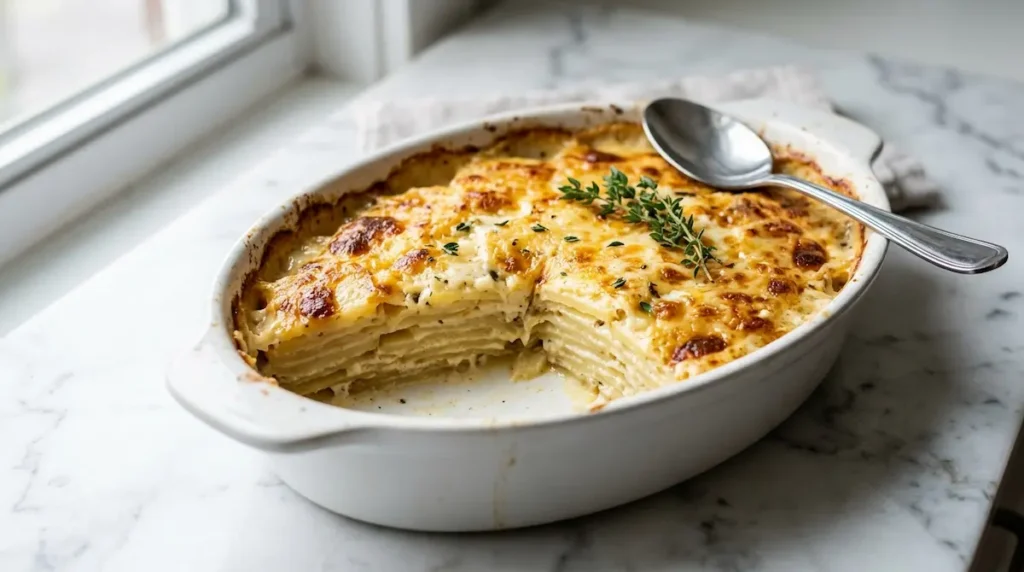
With the foil removed, return the dish to the oven and bake uncovered for 20 to 25 minutes until the top is golden brown and bubbling around the edges and the sauce has reduced and thickened visibly. The potatoes should yield completely to a knife inserted at the center with zero resistance.
If the top is browning too fast before the potatoes are cooked through, cover loosely with foil again and continue baking. Ovens vary significantly and the covered-then-uncovered timing may need a 5 to 10 minute adjustment either way.
Step 6: Rest Before Serving
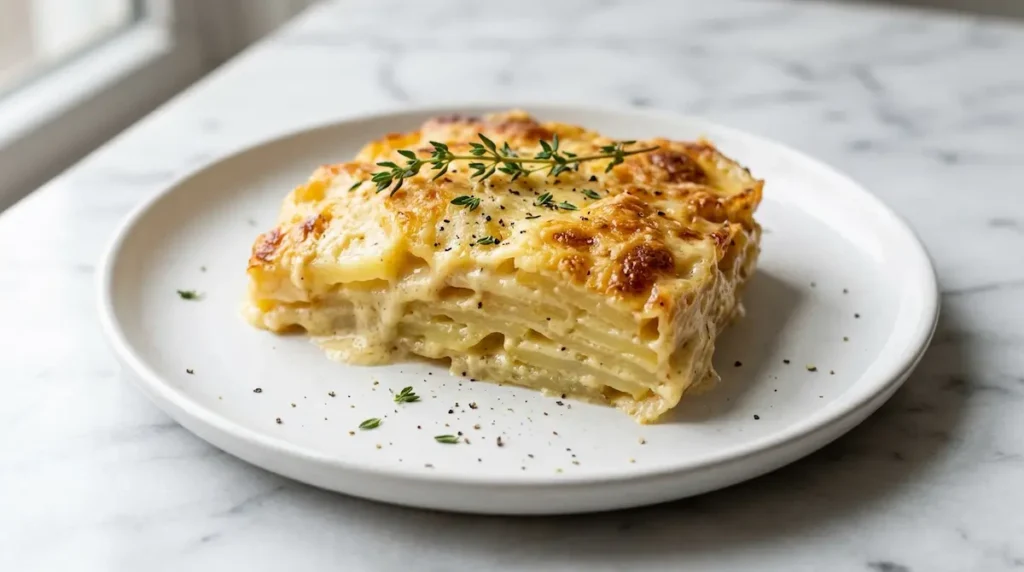
Remove from the oven and rest uncovered for 10 to 15 minutes before cutting and serving. This rest is not optional. The sauce continues to thicken and set as it cools from oven temperature to serving temperature. A scalloped potatoes recipe cut immediately out of the oven will pour liquid sauce across the plate. After 10 to 15 minutes the layers hold and the sauce is creamy and thick.
Scalloped Potatoes vs Au Gratin vs Dauphinoise
| Dish | Cheese | Sauce Base | Origin | Texture |
|---|---|---|---|---|
| Scalloped Potatoes | None (traditional) | Bechamel with cream | American | Creamy, saucy layers |
| Au Gratin Potatoes | Throughout and on top | Bechamel with cheese | French-American | Dense, cheesy, structured |
| Gratin Dauphinois | None | Raw cream, no roux | French (Dauphine region) | Silky, dense, potato-forward |
For the complete academic reference on potato variety characteristics used by food scientists and culinary educators, the University of Minnesota Extension potato variety guide is the most authoritative publicly available reference on potato starch composition and culinary performance.
For the fastest high-protein companion dish to serve alongside this scalloped potatoes recipe, our breaded steak sandwich and our burger bowl recipe are the two most popular pairings on the site with this potato dish.
5 Secrets for the Best Scalloped Potatoes Recipe
These are the five technique decisions that separate a restaurant-quality scalloped potatoes recipe from the watery, curdled, or undercooked versions most people make the first time.
Secret 1: Use Yukon Gold potatoes, not russets. Russets are too starchy and break down into a mealy mush during long oven time. Yukon Golds have medium starch, naturally buttery flavor, and hold their shape through 65 to 70 minutes of baking while still becoming fork-tender. Red potatoes work as a second choice. Avoid russets entirely.
Secret 2: Never rinse the sliced potatoes. The surface starch on freshly sliced Yukon Golds is the natural thickener that helps the cream sauce build body as the dish bakes. Rinsing or soaking in water removes this starch and is the primary cause of watery scalloped potatoes that never thicken properly, even with a heavy roux in the sauce.
Secret 3: Season every single layer individually. One of the most consistent mistakes in scalloped potato recipes is seasoning only the sauce and not the potato layers. Potatoes are dense and absorb flavor slowly. Each layer of potato needs its own light seasoning of salt and pepper before the sauce goes over it.
Secret 4: Build your sauce to a gentle simmer only on the stovetop. The moment a cream-flour sauce reaches a hard boil, the protein in the dairy begins to coagulate and separate. Once broken, the sauce cannot be repaired. Cook over medium heat, whisk constantly, and pull the pan off the heat the moment the sauce coats the back of a spoon.
Secret 5: Add Dijon mustard and nutmeg to the sauce. These two ingredients are invisible in the final dish, meaning no one identifies them by taste, but every person who eats this scalloped potatoes recipe says it tastes significantly richer and more complex than versions without them. The Dijon sharpens the cream and lifts the salt. The nutmeg adds warmth that makes the cream sauce taste three times more expensive than it is.
Scalloped Potatoes Recipe Variations
The base recipe above is the classic no-cheese version. These three variations use the same method with targeted additions.
Cheesy Scalloped Potatoes (Loaded Version)
Add 1 1/2 cups of shredded Gruyere or sharp cheddar to the cream sauce after removing it from the heat, whisking until fully melted before layering. Sprinkle an additional 1/2 cup of cheese over the top layer before the uncovered baking phase. This technically moves the dish into au gratin territory but the flavor result is extraordinary and is what most people picture when they imagine scalloped potatoes at a holiday table.
Scalloped Potatoes with Ham
Add 1 1/2 cups of diced cooked ham between the second and third potato layers. The ham absorbs the cream sauce beautifully during baking and turns this side dish into a complete one-pan meal. Use a good quality thick-cut ham, not deli lunch meat, for the best texture. Our corned beef and cabbage recipe uses a similar layered baking method and makes the perfect St. Patricks Day companion to this scalloped potatoes recipe.
Dairy-Free Scalloped Potatoes
Replace the whole milk with full-fat oat milk and the heavy cream with full-fat coconut cream. Use vegan butter for the roux. The sauce will be slightly thinner but fully functional with an extra 1/8 cup of flour to compensate. The coconut cream adds a subtle sweetness that works well with the thyme and garlic in the sauce.
Make Ahead, Storage, and Reheating
Scalloped potatoes are one of the best make-ahead side dishes for holidays and large dinners because they hold and reheat better than almost any other potato preparation.
Make ahead unbaked: Assemble the full dish through step 3, cover tightly with plastic wrap and then foil, and refrigerate up to 24 hours before baking. Remove from the refrigerator 30 minutes before baking. Add 10 to 15 minutes to the covered baking time to account for the cold start.
Make ahead fully baked: Bake the complete scalloped potatoes recipe, allow to cool fully, cover tightly, and refrigerate up to 3 days. The layers actually set more firmly after a full overnight rest in the refrigerator, making the pre-baked version cut more cleanly than the fresh version.
Reheating: Cover with foil and reheat in a 350 degree Fahrenheit oven for 25 to 30 minutes until heated through. Individual portions reheat well in a microwave at 50% power for 2 to 3 minutes to prevent the sauce from breaking. Do not reheat on high power as the dairy sauce will separate at high microwave temperatures.
Freezing: Scalloped potatoes can be frozen after baking but the texture of the cream sauce changes slightly on thawing. Freeze in individual portions in sealed containers for up to 2 months. Reheat from frozen at 325 degrees Fahrenheit covered for 40 to 45 minutes.
7 Mistakes to Avoid With This Scalloped Potatoes Recipe
I made every one of these mistakes during my first four attempts. Here is the complete list so you do not repeat them.
Mistake 1: Using the wrong potatoes. Russet potatoes have too much starch and break down into a grainy mush at the 60-minute baking mark. Yukon Golds hold their shape and their buttery natural flavor elevates the cream sauce significantly. Red potatoes are the acceptable third choice if Yukon Golds are unavailable.
Mistake 2: Slicing the potatoes too thin or too thick. Thinner than 1/16 inch and the slices disintegrate before the sauce has time to thicken. Thicker than 3/16 inch and the center stays raw while the top browns. The target is 1/8 inch. A mandoline takes the guesswork out completely.
Mistake 3: Rinsing the sliced potatoes in water. Surface starch is the natural thickener that makes cream sauce creamy. Washing it off guarantees a watery result regardless of how much flour you put in the roux. Slice and layer immediately.
Mistake 4: Using low-fat dairy. Low-fat milk and reduced-fat cream have less fat to stabilize the sauce during long oven exposure. They curdle faster and produce thinner, less flavorful results. Whole milk and heavy cream are not negotiable for this recipe.
Mistake 5: Skipping the foil in the first baking phase. Without foil, the top browns and the sauce reduces before the center potato layers have time to cook through. The covered phase is what steams the interior layers to tenderness without burning the surface.
Mistake 6: Not seasoning between layers. Potatoes are dense and bland without sufficient salt. A cream sauce alone cannot season every layer adequately. Season the potato layers individually with a light pinch of salt and pepper before adding sauce at each level.
Mistake 7: Serving immediately out of the oven. The sauce is liquid at oven temperature and does not thicken until it cools slightly during rest. Ten to fifteen minutes of uncovered rest is what transforms a pourable sauce into a creamy thick coating that holds when served.
For the complete food safety reference on dairy-based casserole storage and reheating temperatures, the USDA FoodSafety.gov cold food storage chart for dairy and casserole leftovers provides the authoritative food safety guidelines for cream and dairy-based casseroles like this scalloped potatoes recipe.
For more comfort food potato recipes, our potato filled pastry guide and our sheet pan quesadillas are the two most popular comfort food companion recipes on the site.
What to Serve With Scalloped Potatoes Recipe
Scalloped potatoes are a classic holiday and Sunday dinner side dish. Their rich cream sauce pairs best with proteins that have a strong savory or smoky character to contrast the creaminess.
Holiday pairings: Baked ham is the most classic American pairing with scalloped potatoes. Roast beef, roast chicken, and lamb are all strong secondary options. The cream sauce works as an additional sauce for the protein on the plate, which is why a bold-flavored protein is always a better choice than a mild one.
Weeknight pairings: Pan-seared pork chops, a simple roast chicken, or a grass-fed beef burger bowl all work well alongside this scalloped potatoes recipe for a weeknight comfort food dinner.
Vegetable pairings: Green beans, roasted asparagus, and steamed broccoli are the three vegetables that cut the richness of the cream sauce most effectively. A simple arugula salad with lemon dressing serves the same purpose with zero cook time. Our gochujang eggs make an unexpectedly bold companion to this dish for a brunch or weekend late breakfast spread.
Frequently Asked Questions About Scalloped Potatoes Recipe
What is the best potato for scalloped potatoes recipe?
Yukon Gold potatoes are the best choice for a scalloped potatoes recipe. Their medium starch content and naturally buttery flesh hold shape through 60 to 75 minutes of oven baking without turning mushy while releasing enough starch to help thicken the cream sauce from the inside. Russet potatoes have too much starch and break down into a grainy texture. Red potatoes are an acceptable substitute if Yukon Golds are unavailable. Avoid waxy varieties like fingerlings for this recipe.
How thick should you slice potatoes for scalloped potatoes?
Slice potatoes for scalloped potatoes at 1/8 inch thickness, approximately 3mm. This is the Goldilocks zone: thin enough to cook fully through the center within 60 to 75 minutes, thick enough to hold their shape and maintain distinct layers in the finished dish. A mandoline set to its thinnest or second thinnest setting delivers the most consistent results. Slices cut by hand should be checked for consistency before layering.
Why are my scalloped potatoes watery?
Scalloped potatoes turn watery for three reasons. First, the sliced potatoes were rinsed in water before layering, removing the surface starch that helps the sauce thicken during baking. Second, the cream sauce was brought to a hard boil, breaking the dairy proteins and causing the sauce to separate in the oven. Third, insufficient flour in the roux means the sauce was never thick enough to begin with. All three issues are solved by: no rinsing, a gentle simmer only, and a full 90-second roux cook before adding the dairy.
What is the difference between scalloped potatoes and au gratin?
The primary difference is cheese. Traditional scalloped potatoes have no cheese and are baked in a cream sauce made from butter, flour, milk, and heavy cream. Au gratin potatoes have cheese layered throughout and melted on top, often finished with breadcrumbs under the broiler. Gratin Dauphinois is the French version of scalloped potatoes that uses raw cream with no roux at all. All three use thinly sliced potatoes. The cheese is what distinguishes them.
Can you make scalloped potatoes ahead of time?
Yes. Scalloped potatoes are one of the best make-ahead casseroles for holiday cooking. Assemble unbaked, cover tightly, and refrigerate up to 24 hours. Add 10 to 15 minutes to the covered baking time to account for the cold start. Alternatively, bake fully and refrigerate up to 3 days. The fully baked version actually sets more firmly overnight and cuts more cleanly when reheated. Reheat covered at 350 degrees Fahrenheit for 25 to 30 minutes.
What temperature and how long to bake scalloped potatoes?
Bake scalloped potatoes at 375 degrees Fahrenheit. Cover tightly with foil and bake for 45 minutes, then remove the foil and bake uncovered for 20 to 25 minutes until the top is golden brown and bubbling and a knife inserted at the center meets zero resistance. Total oven time is 65 to 70 minutes. Rest uncovered for 10 to 15 minutes before serving. Ovens vary and the uncovered phase may need 5 to 10 minutes of adjustment.
How do you keep scalloped potatoes from curdling?
Keep scalloped potatoes from curdling by using full-fat dairy only, building a proper roux before adding any liquid, and bringing the sauce to a gentle simmer rather than a hard boil. Bake at 375 degrees Fahrenheit rather than higher temperatures. Low-fat dairy curdles faster and produces a thinner sauce. A proper roux from butter and flour stabilizes the fat proteins against heat separation. Never let the sauce reach a rolling boil at any point from stovetop to oven.
The Only Scalloped Potatoes Recipe You Will Ever Need
Seventeen test batches produced five rules that make this scalloped potatoes recipe work every single time without exception: Yukon Golds only, 1/8 inch slices without rinsing, a full roux cooked to a gentle simmer, season every individual layer, and rest for 15 minutes before you even think about picking up a serving spoon.
The dish that comes out of this process is genuinely one of the best things you can put on a holiday table or a Sunday dinner spread. Creamy, deeply flavored, with distinct potato layers that hold when you cut through them and a golden top that looks like something from a restaurant kitchen.
For the complete comfort food recipe collection to build around this scalloped potatoes recipe, our simple pancake recipe for two is the easiest morning-after companion, our blueberry cottage cheese breakfast bake uses a similar covered-then-uncovered baking method, and our pumpkin bars with cream cheese are the dessert that rounds out any comfort food dinner built around this scalloped potatoes recipe.
Food Safety and Nutritional Disclaimer
The content on fastflavorbites.com is for informational and culinary education purposes only. Nutritional estimates for this scalloped potatoes recipe are based on USDA FoodData Central standard reference data and are approximate values calculated per serving. Actual nutritional values vary based on specific ingredient brands, preparation methods, and portion sizes. Always follow USDA food safety guidelines for dairy-based casserole storage, reheating temperatures, and refrigeration time limits. Do not leave scalloped potatoes at room temperature for longer than 2 hours before refrigerating.